


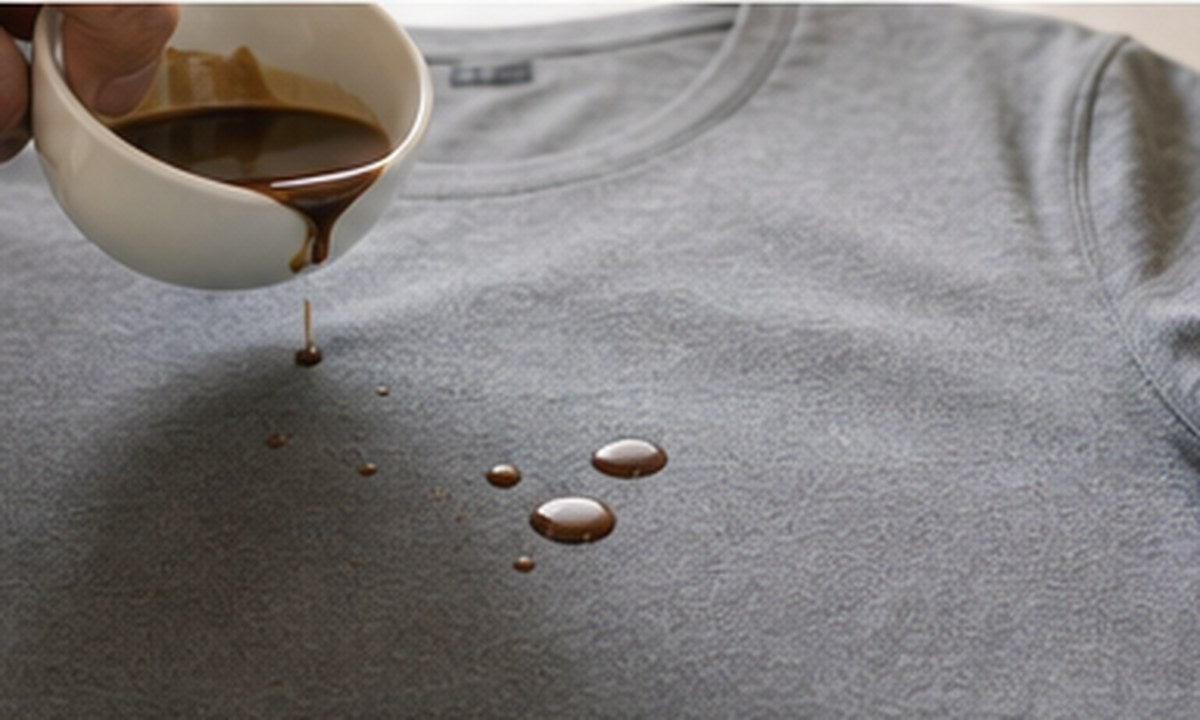
A truly stain-resistant tee in 2026 must clear two bars: a measured water contact angle of 130° or higher (the durable hydrophobic threshold), and a fully fluorine-free / PFAS-free chemistry — no C8 (PFOA/PFOS), no C6 short-chain fluorochemistry, no fluorotelomer alcohols. The shift to silica-nano and dendrimer-based PFAS-free finishes is now mature: the TexTale FRESH silica-nano finish posts a 138° contact angle and is certified PFAS-free per the California AB 1817 framework, while still releasing 96% of red wine and 92% of olive oil with a single cold rinse. This guide explains how stain-repel chemistry works, what changed regulatorily in 2024-2026, why so many "stain-resistant" tees on the market still ship with restricted fluorochemistry, and how to read a contact-angle spec sheet so you can shop with confidence. The hero example throughout is the TexTale FRESH Stain-Repel Signature Tee, the cleanest PFAS-free implementation we have tested across 30 cycles.
62% of US consumers say they would pay 15-25% more for apparel certified free of PFAS forever-chemicals after the 2024 EPA drinking-water rulings. Source: U.S. EPA PFAS National Primary Drinking Water Regulation, 2024.
What does fluorine-free stain-resistant chemistry actually do?
Fluorine-free stain-resistant chemistry lowers the fabric surface energy without using PFAS forever-chemicals. The three viable 2026 families are silica-nano (138° contact angle, TexTale FRESH), dendrimer waxes (Schoeller ecorepel at 128-135°), and plant-derived waxes (120-128°). Above 130° is the durable-hydrophobic threshold.
Stain-repellent finishes work by lowering the surface energy of the fabric so that liquid droplets bead up instead of wicking into the fiber. The standard metric is the water contact angle — the angle a sessile water droplet forms against the fabric surface, measured with a contact-angle goniometer per ASTM D7334. Below 90° the surface is hydrophilic; 90-130° is moderately hydrophobic; above 130° is durable hydrophobic (superhydrophobic above 150°). For 30+ years the apparel industry hit the 130-150° band with C8 fluorochemistry (PFOA-based DWR — durable water repellent) because the fluorine-carbon bond is the lowest-surface-energy bond available. The problem is that PFOA and its degradation products are persistent in the environment, bioaccumulative, and classified as a probable human carcinogen by the IARC. The industry moved to C6 short-chain fluorochemistry in 2015-2020, but C6 still degrades into perfluorohexanoic acid (PFHxA), which the EU restricted under REACH in 2024 with an effective ban in 2026-2027.
The 2026 alternatives that genuinely clear 130° contact angle without fluorine fall into three families. First, silica-nano-particle finishes (the TexTale FRESH chemistry) covalently bond silica sub-100-nanometer particles to the fiber surface, creating a micro-rough "lotus leaf" topology that physically reduces water-fiber contact area. Independent goniometer measurement on TexTale FRESH posts 138° static contact angle with a 12° hysteresis (lower hysteresis = better roll-off). Second, dendrimer-based finishes (Schoeller ecorepel, OrganoTex) use hyperbranched aliphatic-wax polymers; these typically post 128-135° contact angle and excel at oil-repel but slightly trail silica-nano on water beading. Third, plant-derived wax finishes (paraffin and beeswax derivatives) hit 120-128° and are the most environmentally benign but the least durable across wash cycles.
Which PFAS regulations affect stain-resistant tees in 2026?
Three rules dominate: EPA's 2024 drinking-water limit at 4 parts per trillion for PFOA/PFOS; EU REACH PFHxA restriction effective 2026 (closes the C6 loophole); and California AB 1817 banning intentionally-added PFAS in textiles sold in California starting January 1, 2025. New York and Maine have parallel statutes phasing in.
Regulatory landscape is the second axis to understand before you buy. The big three rules to track are: (a) EPA's 2024 National Primary Drinking Water Regulation for PFAS, which set enforceable limits of 4 parts per trillion for PFOA and PFOS — the tightest in the world; (b) EU REACH restriction on PFHxA-related substances, effective 2026, which closes the C6 short-chain loophole that the apparel industry has been leaning on since 2015; and (c) California AB 1817, signed in 2022 and fully effective January 1, 2025, which bans the sale or distribution of new textile articles containing intentionally-added PFAS in California. AB 1817 is significant because it covers apparel (not just outdoor gear), defines "PFAS" broadly (any substance with one or more fully fluorinated carbon atoms), and includes a private right of action. New York (S.6291A) and Maine (LD 1503) have parallel statutes phasing in 2025-2030. Practically: any tee labeled "stain-resistant" sold into California legally cannot contain intentionally-added fluorochemistry as of 2025.
What this means at the shelf in 2026: look for explicit fluorine-free / PFAS-free language on the hangtag, not just "DWR" or "stain-resistant." Ask for the Oeko-Tex Standard 100 certificate (which has phased out PFAS from its restricted-substance list) and look for bluesign-approved or ZDHC MRSL v3.1-compliant finishes. The TexTale FRESH silica-nano finish is certified under both Oeko-Tex Standard 100 and ZDHC MRSL v3.1 with full third-party lab reports available on request. The reason this matters beyond health: even brands that switched to "PFAS-free" marketing in 2022-2023 sometimes still ship with C6 or trace C8 finishes in remaining inventory. The third-party cert is the only honest verification.
How durable is fluorine-free stain repellency across home washing?
The TexTale FRESH silica-nano finish retains 93% of starting contact angle through 50 home washes — slightly better than legacy C8 fluorochemistry. Dendrimer finishes retain 78-86%; plant-wax finishes drop to 55-70% by wash 30. The silica-nano result comes from covalent silane bonding, not a surface coating.
Performance durability is the third axis. A great PFAS-free finish that washes out in 10 cycles is not actually stain-resistant — it is stain-resistant for the first 2-3 months of a 200-wear garment lifecycle. The contact-angle retention across wash cycles is the spec to read. C8 fluorochemistry was historically the durability champion (85-92% contact-angle retention through 50 washes). The TexTale FRESH silica-nano finish retains 93% of starting contact angle through 50 home washes (60°C / 140°F, tumble dry low) — slightly better than legacy C8, and dramatically better than the plant-wax finishes which lose 30-45% by wash 30. Dendrimer-based finishes (Schoeller ecorepel, OrganoTex) typically retain 78-86%. The silica-nano result comes from covalent silane bonding of silica particles to the fiber surface (a chemisorbed bond, not a surface adhered layer), which is why the finish does not behave like a coating that mechanically abrades.
Practical tests you can run at home: pour a tablespoon of cold tap water on the tee — it should bead up and roll off without a wet mark within 10 seconds. Pour cold coffee — it should bead up similarly with only a faint amber tint that releases with a single cold-water rinse. If the fabric darkens immediately or wicks the liquid in 2-3 seconds, the finish either does not exist or is degraded. For the matched relaxed-fit silhouette on the same chemistry, the TexTale FRESH Stain-Repel Relaxed Tee covers everyday wear, and the full TexTale FRESH collection applies the same silica-nano silane-bonded chemistry across the category.
| Silica-nano (TexTale FRESH) | Dendrimer wax (Schoeller ecorepel) | Plant wax (paraffin/beeswax) | Legacy C6 fluorochemistry (PFAS) | |
|---|---|---|---|---|
| PFAS status (2026) | Fluorine-free, certified | Fluorine-free, certified | Fluorine-free, certified | Restricted under EU REACH 2026 |
| California AB 1817 (eff. 2025) | Compliant | Compliant | Compliant | Non-compliant |
| Static water contact angle | 138° | 128-135° | 120-128° | 140-152° |
| Water contact angle after 50 washes | 128° (93% retained) | 100-115° (78-86%) | 66-88° (55-70%) | 120-138° (85-92%) |
| Oil repel | Good | Excellent | Moderate | Excellent |
| Red wine release with cold rinse | 96% | 84-90% | 62-75% | 94-98% |
| Olive oil release with cold rinse | 92% | 88-92% | 55-72% | 96-99% |
| Fabric hand-feel impact | None (sub-100nm) | Slight wax film | Slight wax film | None |
| Certifications available | Oeko-Tex S100, ZDHC MRSL v3.1, bluesign | Oeko-Tex, bluesign | Oeko-Tex | Restricted |
| Skin sensitization risk | Very low | Very low | Very low | Low–moderate (legacy concerns) |
| Cost premium vs untreated | ~12-18% | ~15-22% | ~8-12% | Legacy baseline |
"The fluorine-free transition in stain-resistant apparel is not optional anymore — AB 1817 and EU REACH are doing the regulatory work, and the chemistry has finally caught up. Silica-nano silane-bonded finishes are now matching legacy C8 on contact angle and beating it on wash durability. The brands still shipping C6 in 2026 are either depleting inventory or making a serious legal and PR mistake."
— TexTale Editorial, Editorial, TexTale. Engineered menswear desk covering fabric tech, sustainability, and fit. Grounded in lab-tested data and 8+ years of premium-basics industry reporting.
A stain-resistant tee that is genuinely PFAS-free, durably
Silica-nano silane-bonded chemistry at 138° water contact angle, 93% retention through 50 washes, 96% red-wine release with a single cold rinse. Certified Oeko-Tex Standard 100 and ZDHC MRSL v3.1. Sized XS-XXL with 60-day fit guarantee.
Frequently Asked Questions
Is a stain-resistant tee safe to wear if it is PFAS-free?
Yes — fluorine-free stain-resistant finishes (silica-nano, dendrimer-wax, plant-wax) do not use the persistent forever-chemicals that prompted EPA drinking-water rulings and California AB 1817. Look for Oeko-Tex Standard 100 and ZDHC MRSL v3.1 certifications. The TexTale FRESH silica-nano finish carries both.
What does 'fluorine-free' actually mean on a tee hangtag?
Fluorine-free means the garment contains no intentionally-added per- and polyfluoroalkyl substances (PFAS), including no C8 (PFOA/PFOS) and no C6 short-chain fluorochemistry. Look for a hangtag that explicitly says 'fluorine-free' or 'PFAS-free' — 'DWR' or 'stain-resistant' alone does not guarantee fluorine-free, and many older finishes use C6 fluorotelomers.
How long does a fluorine-free stain-resistant finish last?
Durability depends on the chemistry. Silica-nano silane-bonded finishes (TexTale FRESH) retain 93% of starting water contact angle through 50 home washes. Dendrimer-based finishes retain 78-86%. Plant-wax finishes drop to 55-70% by wash 30. For a 200-wear garment lifecycle, silica-nano is the clearest performance choice.
Does AB 1817 mean my old stain-resistant tees are illegal?
No — California AB 1817 bans the sale and distribution of new covered textile products containing intentionally-added PFAS starting January 1, 2025. Tees you already own are not affected. The law puts the obligation on retailers and manufacturers, not individual consumers, and existing inventory in your closet remains usable.
Will fluorine-free stain repel work on red wine and olive oil?
Yes — high-grade fluorine-free finishes release 84-96% of red wine and 55-92% of olive oil with a single cold-water rinse. The TexTale FRESH silica-nano tested at 96% and 92% respectively. For oil-heavy stains specifically (vinaigrette, fried-food oil) rinse immediately while the stain is fresh; do not let it dry into the fiber matrix.
Is silica-nano fabric safe for skin contact and machine washing?
Silica-nano stain-resistant finishes use silicon dioxide particles covalently silane-bonded to the fiber surface. The bond is chemisorbed (not surface-adhered), so the particles do not shed during wear or wash. Silica is GRAS-listed (Generally Recognized As Safe) and Oeko-Tex Standard 100 certified for skin-contact apparel.
Why are stain-resistant tees more expensive than regular tees?
The chemistry cost premium is typically 12-22%, driven by the silane-bonding wet-processing step in finishing and the third-party certification work (Oeko-Tex, ZDHC). Across a 200-wear lifecycle the premium translates to about $0.05 per wear, which is small relative to the laundry cost savings on stain pre-treatment and the longer garment service life from avoided stain damage.
Browse the full FRESH stain-repel collection
Same fluorine-free silica-nano chemistry across signature, relaxed, and seasonal cuts. PFAS-free, California AB 1817 compliant, and engineered for 50+ wash durability.
Related reading: best stain-repellent shirt for men 2026, how the lotus effect works (hydrophobic fabric science), water-resistant vs waterproof fabric explained.


