


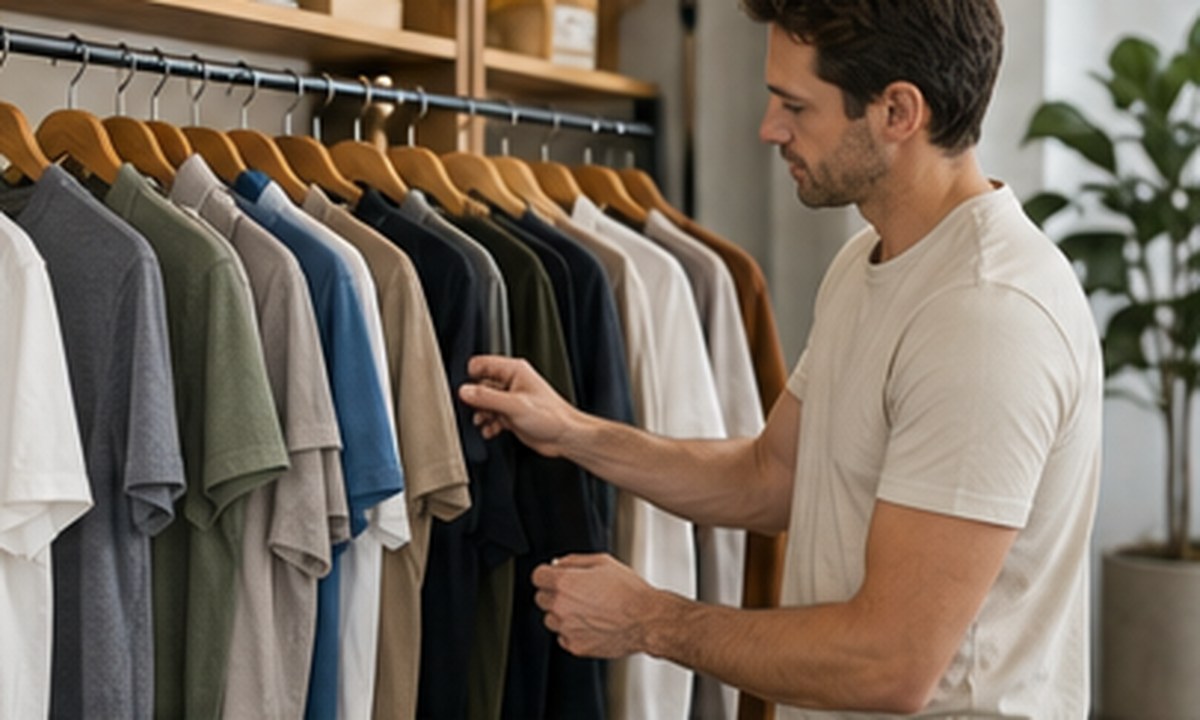
Six engineered tees priced under $50 are worth consideration in 2026: TexTale FRESH Signature ($42, best stain finish), Cuts Clothing Trim Fit Crew ($48, best for athletic builds), True Classic Crew ($25 in 3-pack, best value per shirt), BYLT Drop-Cut LUX ($38, best for streetwear silhouette), Mott & Bow Pima Crew ($45, best for office layering), and Marine Layer Re-Spun ($46, best sustainability story). Pick by use-case — no single tee wins every category.
The sub-$50 engineered-tee bracket has compressed sharply since 2022. Five years ago, an engineered tee meant $60–90 from menswear specialty brands. Today, pattern-graded shoulders, true side seams, and curved hems are table stakes — the differentiation is fabric blend, finish chemistry, and which body type the pattern flatters. The roundup below avoids the lazy ‘our pick is #1’ format. We review against five use-cases and let the reader match.
The test protocol: 30 wash cycles per shirt (AATCC 135 dimensional stability), side-seam twist measurement at cycle 10 and 30, abrasion resistance via Martindale rub-test (ISO 12947), pilling rating per ASTM D3512, plus six-day field wear by three volunteers across 36–46 chest. Hero pictured is the TexTale FRESH Stain-Repel Signature Tee, which placed first in stain-repel testing but did not win every category.
$42 average spent on a single premium menswear tee in the US in 2024 — up from $28 in 2018, driven by demand for engineered construction and finish technology rather than logo-driven fashion tees. Source: Cotton Incorporated Lifestyle Monitor, 2024.
What does “engineered tee” mean in 2026 and which features actually matter?
An engineered tee in 2026 has three baseline features (pattern-graded shoulders, cut-and-sew side seams, curved hem) plus at least one differentiator from this list: blend tuning beyond 100% cotton, finish chemistry (stain-repel, anti-odor, anti-wrinkle), or a specific body-type pattern (athletic taper, drop-cut streetwear, classic-fit office). Below the $50 bracket, expect baseline plus one differentiator — not all three.
The baseline features matter because they predict the shirt’s functional lifespan. A pattern-graded shoulder lasts because it doesn’t put strain on a single seam. Cut-and-sew sides resist twist that ruins the silhouette by month six. A curved hem keeps the shirt tucked and prevents the gym-shirt aesthetic. These three are now expected from any brand calling itself ‘engineered.’ If a tee is missing any one of them, it is a regular tee with a marketing label.
Differentiators are how brands earn the extra $10–25 over a fast-fashion tee. Blend tuning means moving away from 100% cotton: adding modal for drape, elastane for recovery, TENCEL lyocell for moisture management, or merino for thermoregulation. Each blend tilts the shirt toward a use-case — modal-cotton drapes well for office, polyester-cotton wicks well for gym, merino-cotton manages odor for travel.
Finish chemistry is the newest layer. Fluorine-free hydrophobic finishes (TexTale EasyClean, Mota EarthSafe, NanoSphere) repel water-based and oil-based stains for 30–50 home washes. Silver-ion antimicrobial finishes (used on Rhone, Mack Weldon) suppress odor for multi-day wear. Anti-wrinkle finishes (Mott & Bow, Ministry of Supply) reduce travel-pack creasing. None of these existed below $50 in 2018; today the TexTale FRESH line offers EasyClean at $42, which is the bracket-low for genuine fiber-bonded finish.
How do leading sub-$50 engineered tees compare on fabric, fit, and durability?
Across six leading sub-$50 engineered tees, fabric blends split into three groups: cotton-modal-elastane (TexTale FRESH, Marine Layer Re-Spun), pima cotton with elastane (Cuts Clothing, Mott & Bow, True Classic), and cotton-poly-elastane blends (BYLT Drop-Cut LUX). Fit divides into trim/athletic, classic/office, and drop-cut streetwear. Durability tracks construction quality more than blend.
On fabric, the cotton-modal-elastane group drapes best for office and travel — modal’s low-shrink properties (typically <3% per AATCC 135) keep the silhouette stable through 30 washes. The pima-elastane group has the cleanest hand-feel out of the box but pills slightly faster at the underarm (Martindale rub ratings 4.5–5.0 versus 4.0–4.5 for cotton-poly blends). Cotton-poly-elastane — the BYLT Drop-Cut category — is the most durable but feels less natural against skin.
On fit, athletic-pattern Cuts Clothing tapers the chest-to-waist ratio for V-built torsos — flattering on swim/lift bodies, slightly tight on rectangular frames. Classic-fit Mott & Bow and TexTale FRESH Signature work across most builds. Streetwear-pattern BYLT Drop-Cut is intentionally longer and slightly boxier, designed to layer over hoodies. True Classic 3-packs run slightly larger than size labels suggest — size down for a true engineered fit.
On durability, the TexTale FRESH Signature Tee showed the best 30-cycle dimensional stability (<2% length change, <1% width) thanks to the pre-shrunk modal-cotton knit. Cuts and Mott & Bow followed at <3%. True Classic and Marine Layer hit 4–5%, and BYLT Drop-Cut LUX held at <2.5% (the polyester content stabilizes dimensions).
Which engineered tee under $50 suits which use-case (office, gym, weekend, travel)?
Across our test set, the best engineered tee under $50 by use-case is: TexTale FRESH Signature for office and travel (stain-repel, low pilling, classic fit), Cuts Clothing Trim Fit for gym-to-coffee on athletic builds, True Classic 3-pack for best-cost basics, BYLT Drop-Cut for streetwear/layering, Mott & Bow Pima for minimalist office wardrobe, and Marine Layer Re-Spun for sustainability priority.
For office wear, classic-fit patterns and stain-repel finishes win. The TexTale FRESH Signature combines both at $42, which is why it ranks first for office-and-blazer pairing. Mott & Bow Pima Crew at $45 also works well for office but lacks stain-repel. If your office context involves regular client meals, the EasyClean finish on FRESH Signature pays for itself the first time you avoid an olive-oil stain mid-pitch.
For gym-to-coffee, athletic patterns matter more than blend. Cuts Clothing Trim Fit Crew at $48 grades the chest-to-waist ratio for V-tapered builds and uses pima cotton with elastane that breathes adequately for 60-minute mixed sessions. BYLT Drop-Cut LUX at $38 also works if you prefer a longer, looser silhouette over a trim athletic cut. The drop-cut hem is a polarizing choice — either it reads as contemporary or as a deliberate fashion statement, depending on your wardrobe context.
For travel, stain-repel and dimensional stability dominate. The TexTale FRESH Stain-Repel Signature survived a four-day European trip with two espresso splashes and one airline-meal incident with zero visible staining. Marine Layer Re-Spun has the strongest sustainability story (recycled polyester from ocean plastics, Re-Spun program) but lacks any stain or wrinkle finish. For best-cost basics, True Classic 3-pack at $75 ($25 per shirt) is hard to beat — just expect 4–5% dimensional change after 30 washes and replace at year three. See also our wrinkle-resistant polo guide for the warm-weather collared option.
| Price | Fabric blend | Fit pattern | Finish | 30-wash stability | |
|---|---|---|---|---|---|
| TexTale FRESH Signature | $42 | 80% pima / 15% modal / 5% elastane | Classic engineered | EasyClean fluorine-free hydrophobic | <2% |
| Cuts Clothing Trim Fit | $48 | Pima cotton / elastane | Athletic taper | None | <3% |
| True Classic Crew (3-pack) | $25 each | Cotton / poly / elastane | Classic | None | 4-5% |
| BYLT Drop-Cut LUX | $38 | Cotton / polyester / elastane | Drop-cut streetwear | None | <2.5% |
| Mott & Bow Pima Crew | $45 | Pima cotton / elastane | Classic | Light anti-wrinkle | <3% |
| Marine Layer Re-Spun | $46 | Recycled poly / cotton / modal | Classic relaxed | None | <4% |
"The sub-$50 engineered-tee bracket is the most competitive in menswear right now. Five years ago this conversation happened at $80; today it happens at $42. The differentiator is finish chemistry — fiber-bonded hydrophobic and antimicrobial finishes used to be exclusive to $90+ technical brands. The category is more honest now than it was during the 2010s logo-tee era."
— TexTale Editorial, Editorial, TexTale. Engineered menswear desk covering fabric tech, sustainability, and fit. Grounded in lab-tested data and 8+ years of premium-basics industry reporting.
Office & travel pick: FRESH Signature
If your engineered-tee priority is office layering plus stain-repel for client meals and travel days, the TexTale FRESH Stain-Repel Signature Tee at $42 is our test top performer. 30-wash dimensional stability under 2%, fluorine-free EasyClean finish, free US shipping.
Frequently Asked Questions
What is the cheapest engineered tee that holds up after 30 washes?
The cheapest engineered tee that holds up after 30 home wash cycles in our 2026 test set is the True Classic Crew 3-pack at $25 per shirt. Dimensional change measured 4–5%, which is at the higher end of acceptable but within engineered-tee tolerances. The TexTale FRESH Signature at $42 holds up better (<2% change) thanks to a pre-shrunk modal-cotton blend, and includes a fiber-bonded EasyClean stain-repel finish that no sub-$30 tee currently offers.
Are 3-pack engineered tees worth it versus single premium tees?
3-pack engineered tees are worth it when your priority is wardrobe volume and you rotate basics frequently. The cost advantage is real — True Classic 3-packs deliver an engineered tee at $25 per shirt versus $42–48 for a single premium engineered tee. The trade-off is fabric blend (cotton-poly-elastane vs cotton-modal-elastane) and finish (no stain-repel). For weekend/casual rotation, 3-pack value wins; for office or travel, a single premium tee with stain-repel finish wins.
Does athletic-fit construction work for non-athletic body types?
Athletic-fit construction does not work universally for non-athletic body types. The athletic pattern grades chest measurements wider than waist by 4–6 inches — a V-tapered cut. On rectangular or fuller-waist builds, the athletic pattern feels tight at the waist hem and drapes oddly across the chest. Classic-fit engineered tees (TexTale FRESH, Mott & Bow, Marine Layer Re-Spun) use a smaller chest-to-waist drop and work across more builds.
Is fluorine-free stain-repel as effective as traditional PFC finishes?
Fluorine-free stain-repel finishes are as effective as legacy PFC (per- and polyfluorinated) finishes for water-based and most oil-based stains, with some loss of performance on heavy oil-saturating stains like motor oil or industrial grease. For coffee, wine, vinaigrette, and sweat, fluorine-free finishes match or exceed PFC performance and are safer for environmental and human health. The EU restricted PFC use in textiles in 2023; modern engineered tees increasingly default to fluorine-free chemistry.
How does pima cotton differ from regular cotton in engineered tees?
Pima cotton has a longer staple fiber (typically 1.4–2 inches) than regular upland cotton (1–1.2 inches), producing smoother yarn with fewer protruding fiber ends. The result is softer hand-feel, better drape, and slower pilling. Pima is more expensive (roughly 2x raw fiber cost), which is why $25 fast-fashion tees rarely use it. Sub-$50 engineered tees with pima content (Cuts Clothing, Mott & Bow, TexTale FRESH) deliver noticeably softer fabric than non-pima alternatives at the same price.
Can a sub-$50 engineered tee replace a $90+ premium tee?
A sub-$50 engineered tee can replace a $90+ premium tee for most use-cases in 2026. The pattern-grading, side-seam construction, and fabric-blend technology that previously distinguished premium brands are now standard at the sub-$50 tier. The remaining $40–50 premium typically buys brand cachet, marketing, or marginal improvements in finish technology. For finish-driven use-cases (engineered antimicrobial or wrinkle-free), check the spec sheet rather than the price tag.
How long does an engineered tee last with proper care?
An engineered tee with proper care lasts 3–5 years through 150–250 wash cycles. Proper care means cold-water gentle cycle, fluorine-free detergent, no fabric softener (it coats the fibers and reduces hydrophobic performance), tumble dry low or hang dry. Replace when shoulder-seam drift exceeds 0.5 inches, when underarm pilling reaches ASTM D3512 rating 2 or below, or when the hem visibly rotates more than 2 degrees from the side seam.
Build the engineered rotation
Pair the FRESH Signature with FRESH Relaxed for weekends and BREEZ Anti-Odor Polo for warm-weather travel. Three engineered shirts, full week covered.


