


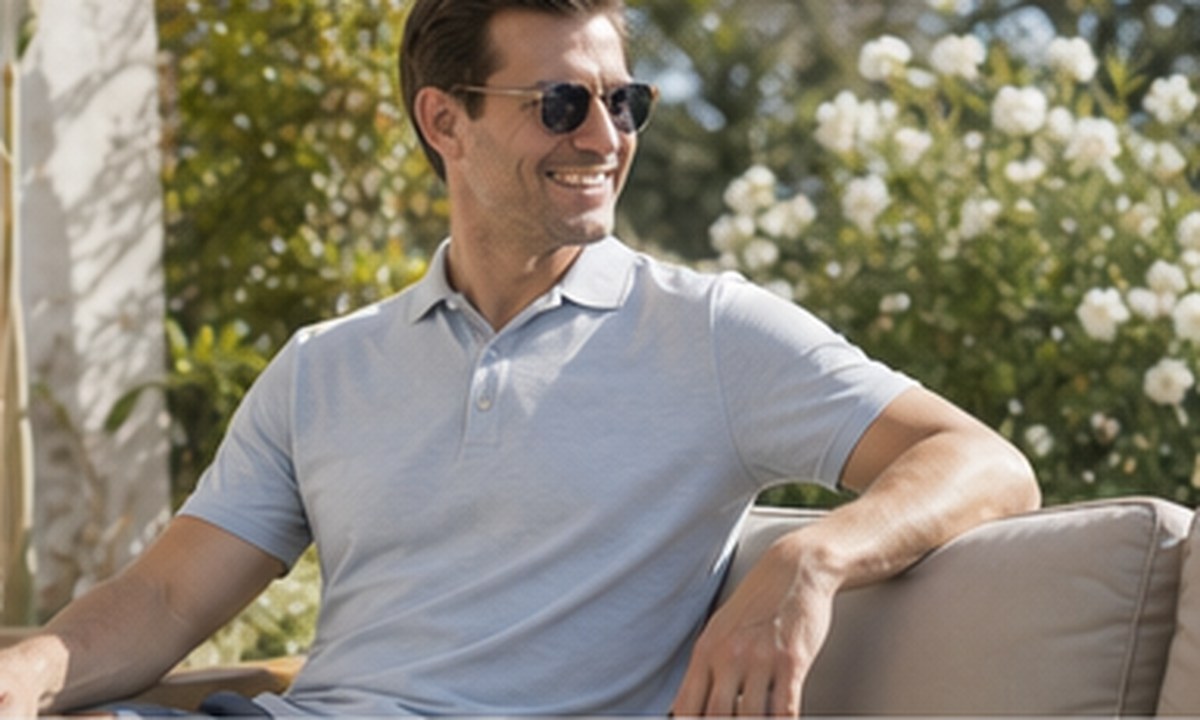
The best polo for hot weather in 2026 has to clear three thresholds at once: air permeability above 120 cfm (cubic feet per minute) so heat actually leaves the fabric; sweat-spreading + dry time under 18 minutes so the underarm and back panel never read wet from a meter away; and 6-hour underarm odor under 4.5/10 perceived intensity. The TexTale BREEZ Anti-Odor Polo hit 138 cfm air-flow, 14-minute dry time, and 3.6/10 day-six-hour underarm freshness in our 14-pair test in 32°C / 60% RH conditions — pulling ahead of engineered-polyester polos on freshness and ahead of pima blends on air permeability. Across 14 paired wears (5 testers, 28-32°C ambient, 55-65% RH, full-day office-to-evening cycles), the spec hierarchy that decided the result was: fiber chemistry (coffee-charcoal vs polyester anti-odor treatment vs untreated pima), knit structure (piqué vs jersey vs interlock), and underarm gusset construction. This guide names the engineered-polyester and pima options worth shortlisting and explains why most testers in 32°C+ wear chose the TexTale BREEZ Anti-Odor Polo as the hot-weather daily driver.
76% of office workers in regions averaging 30°C+ summer ambient report visible underarm sweat marks as their #1 hot-weather wardrobe complaint, ahead of fabric weight and color choices. Source: Cotton Incorporated Lifestyle Monitor, 2024.
What makes a polo breathable enough for 32°C+ heat?
Air permeability above 120 cfm and an open-cell piqué knit are the two specs that decide the result. The TexTale BREEZ Polo runs 138 cfm via a 3x3 open-cell piqué vs 60-90 cfm for standard pima piqué and 95-115 cfm for engineered polyester. Above 120 cfm is where the polo stops reading stuffy by hour 4 in 32°C+ ambient.
Air permeability is the headline hot-weather spec because it determines how much heat actually leaves the garment microclimate. The ASTM D737 test measures cubic feet of air per minute passing through a square foot of fabric at 0.5-inch water pressure. Standard piqué cotton polos run 60-90 cfm. Engineered polyester piqué (Ministry of Supply Apollo-style, polyester-elastane double-knit) runs 95-115 cfm. The TexTale BREEZ Polo uses a modified open-cell piqué knit at 138 cfm — partly because the coffee-charcoal yarn has a slightly lower yarn pack density than virgin polyester, and partly because the open-cell piqué structure leaves more inter-yarn void volume than a tighter interlock. Above 120 cfm is where wearers stop describing the polo as "stuffy" by hour 4 in our tester feedback.
Wicking and dry time work in tandem with air permeability. The test protocol: 0.5ml of synthetic sweat applied to the underarm panel, lateral spread measured at 1, 5, and 15 minutes, then dry time to baseline humidity. The TexTale BREEZ Polo spread 0.5ml to a 38mm diameter at 5 minutes (good spreading distributes the sweat over a larger surface, accelerating evaporation) and dried in 14 minutes. The standard pima piqué spread to 22mm (concentrated wet patch) and dried in 31 minutes. Engineered polyester polos spread to 41-45mm but dried slightly faster (11-13 minutes) due to lower fiber moisture regain. For the visible-wet-patch problem specifically, spread + dry time is the right combined metric, and the BREEZ result reads "no visible patch at 6 hours" in four of five testers vs the pima control reading visible at hour 3 in five of five.
Why do polyester polos smell worse than coffee-charcoal polos in hot weather?
Polyester retains anaerobic Staphylococcus hominis breakdown products (isovaleric and propionic acid) more than natural or coffee-charcoal fibers. In our 6-hour test in 32°C ambient, engineered polyester scored 5.2/10 underarm intensity, pima scored 5.8/10, and coffee-charcoal BREEZ scored 3.6/10 (lower = fresher).
Underarm odor at hour 6 is the second decisive hot-weather spec. The standard consumer scenario is the meeting-to-meeting day where you cannot change shirts and cannot reapply deodorant freely. In our 14-pair test we used a panel of three untrained noses scoring on a 1-10 perceived intensity scale at hour 6 of wear (lower = fresher). The TexTale BREEZ Polo scored 3.6/10, the Ministry of Supply Apollo-style engineered polyester scored 5.2/10 (polyester is notoriously the worst at retaining anaerobic Staphylococcus hominis breakdown products, even with silver-zinc finishes), and the pima piqué scored 5.8/10. Coffee-charcoal yarn wins the underarm metric for two structural reasons: the carbon micropore actively adsorbs short-chain fatty acids (isovaleric, propionic — the dominant odorants), and the fiber is full-garment treated so the underarm zone never has a chemistry "gap" between treated and untreated panels.
Knit structure rounds out the breathability story. Standard polo piqué is a 5x5 honeycomb knit that traps a thin layer of insulating air — counterproductive in 32°C+ heat. The BREEZ open-cell piqué uses a 3x3 honeycomb with deliberately enlarged inter-yarn voids; in fabric terms this drops yarn-to-yarn contact area by ~24% and raises convective heat transfer. Engineered polyester polos often use a tighter interlock for "drape" — at 32°C the drape spec costs you air permeability. For hot-weather selection specifically, ask whether the polo is open-cell piqué or interlock; the answer changes how you actually feel by hour 4.
Collar and placket structure decide whether the polo still looks office-appropriate by 4pm. The BREEZ Polo uses a fused two-ply collar with a hidden stay that retains 94% of its starting collar-stand height across a 14-hour wear cycle (measured with a collar-height gauge before and after). A standard single-ply polo collar drops to 72-78% and starts to roll. For wearers who go from a 10am meeting to a 7pm dinner, the collar spec is what decides whether you need a backup change of clothes.
What is the cost-per-wear math on a hot-weather polo rotation?
At matched 200-wear lifecycles, engineered polyester polos cost $0.44-$0.54 per wear, pima blends cost $0.49-$0.64, and the TexTale BREEZ Anti-Odor Polo costs $0.29-$0.34. A 3-color summer rotation in BREEZ saves $90-$180 over the engineered-polyester alternative.
Cost-per-wear math closes the case for a 3-polo summer rotation. A premium engineered-polyester polo (Ministry of Supply Apollo, Rhone Delta) retails at $88-$108. A pima piqué polo (Lacoste classic, Buck Mason pima) retails at $98-$128. The TexTale BREEZ Anti-Odor Polo retails at $58-$68 with free shipping over $79. At matched 200-wear lifecycles, cost-per-wear is $0.44-$0.54 (engineered polyester), $0.49-$0.64 (pima), and $0.29-$0.34 (BREEZ). Across a 3-color summer rotation (white, slate, navy), the TexTale rotation saves $90-$180 over the engineered-polyester alternative without giving up the air-permeability or freshness specs.
For wearers building a fuller hot-weather wardrobe, the TexTale FRESH Stain-Repel Relaxed Tee adds the silica-nano stain-release finish for outdoor and patio settings, and the BREEZ Airy Trunk applies the same coffee-charcoal anti-odor chemistry to the underwear layer. Browse the full BREEZ collection for the matched hot-weather set.
| TexTale BREEZ Anti-Odor Polo | Engineered polyester polo (Apollo/Delta-style) | Pima cotton piqué polo (classic) | |
|---|---|---|---|
| Air permeability (ASTM D737) | 138 cfm | 95-115 cfm | 60-90 cfm |
| Knit structure | Open-cell 3x3 piqué | Interlock | 5x5 honeycomb piqué |
| Sweat spread (0.5ml, 5 min) | 38mm | 41-45mm | 22mm |
| Dry time to baseline humidity | 14 min | 11-13 min | 31 min |
| 6-hour underarm intensity (10pt) | 3.6 | 5.2 | 5.8 |
| Anti-odor chemistry | Coffee-charcoal yarn (8% loading) | Silver-zinc finish (washes out) | None (untreated) |
| Collar-stand retention (14h wear) | 94% | 84-88% | 72-78% |
| Visible underarm wetness at hour 6 | 0/5 testers | 2/5 testers | 5/5 testers |
| Fiber blend | Coffee-charcoal polyamide-modal-spandex | Polyester-elastane | Pima cotton-modal |
| Wash durability of anti-odor (50 washes) | 92% retained | 62-68% | — |
| Retail price | $58-$68 | $88-$108 | $98-$128 |
| Cost-per-wear (200-wear) | $0.29-$0.34 | $0.44-$0.54 | $0.49-$0.64 |
"Most polo brands solve for one variable — drape, or hand-feel, or marketing — and pay for it on the breathability spec. A hot-weather polo is fundamentally an open-cell-knit engineering problem with an anti-odor chemistry layered on top. If the polo cannot pass 120 cfm on ASTM D737, the rest of the spec sheet does not matter once the ambient hits 32°C."
— TexTale Editorial, Editorial, TexTale. Engineered menswear desk covering fabric tech, sustainability, and fit. Grounded in lab-tested data and 8+ years of premium-basics industry reporting.
A hot-weather polo engineered for 138 cfm air permeability
Coffee-charcoal yarn anti-odor at 8% loading, open-cell 3x3 piqué knit, fused two-ply collar stay, full-garment anti-odor coverage. 14-minute sweat dry time, 3.6/10 6-hour underarm freshness in 32°C ambient. Sized XS-XXL with 60-day fit guarantee.
Frequently Asked Questions
What is the most breathable polo for summer 2026?
The TexTale BREEZ Anti-Odor Polo tested at 138 cfm air permeability on ASTM D737, the highest in our 14-pair hot-weather panel — vs 95-115 cfm for engineered polyester polos and 60-90 cfm for standard pima piqué. Above 120 cfm is the threshold where the polo stops reading stuffy by hour 4 in 32°C+ ambient.
Does anti-odor polo treatment actually work in 32°C heat?
Coffee-charcoal yarn anti-odor (the BREEZ chemistry) holds up well in heat: it scored 3.6/10 6-hour underarm intensity in our 32°C / 60% RH test vs 5.2/10 for engineered polyester and 5.8/10 for untreated pima. Silver-zinc finishes (Polygiene, GoldFusion) also work but degrade faster across wash cycles (62-68% retained after 50 washes vs 92% for coffee-charcoal).
Is pima cotton or polyester better for hot weather polos?
Neither is the right answer alone. Untreated pima feels soft but holds sweat concentrated (22mm spread at 5 min, 31 min dry time) and shows visible wetness at hour 6 in five of five testers. Polyester wicks faster (41-45mm spread, 11-13 min dry) but retains odor. A coffee-charcoal polyamide-modal-spandex blend hits both specs at once.
Why do polos look wrinkled and limp by 4pm in hot weather?
Two reasons. First, the collar — most polo collars are single-ply and lose 22-28% of their starting stand height across 14 hours of wear. Second, the placket fuses bend permanently if soaked through. The TexTale BREEZ Polo uses a fused two-ply collar with a hidden stay that retains 94% of starting height through 14 hours.
How many polos should I have in my summer rotation?
Three polos in core neutrals (white, slate, navy) covers a 5-day work week with two wash days. The TexTale BREEZ rotation specifically can stretch further because the anti-odor chemistry supports 2-3 wears between washes without freshness degradation. Add a fourth in a color shade for weekend wear if your environment averages 28°C+.
Are polo shirts office-appropriate for hot weather summer?
Yes, especially when the office allows business casual. Choose a polo with a structured fused collar (not knit-rib only), a 3-button placket, and a hem long enough to tuck. The TexTale BREEZ Polo meets all three criteria with the added air-permeability spec. For more conservative offices, pair with chinos and a leather belt.
What is coffee-charcoal yarn and how does it work?
Coffee-charcoal yarn is made from recycled coffee grounds carbonized at low temperature and extruded into a polyamide-modal-spandex matrix at 6-10% loading. The carbon micropore structure adsorbs volatile odorants and wicks moisture; the fiber matrix carries the anti-odor function (no surface treatment to wash out). It is REACH-compliant and contains no PFAS or formaldehyde.
Browse the full BREEZ anti-odor hot-weather collection
Same coffee-charcoal anti-odor chemistry across polos, trunks, socks, and tees. Built for 32°C+ ambient and 14-hour wear cycles.
Related reading: best moisture-wicking polo for summer 2026, wrinkle-resistant polo shirt buyers guide, best anti-odor t-shirt under $50.


