


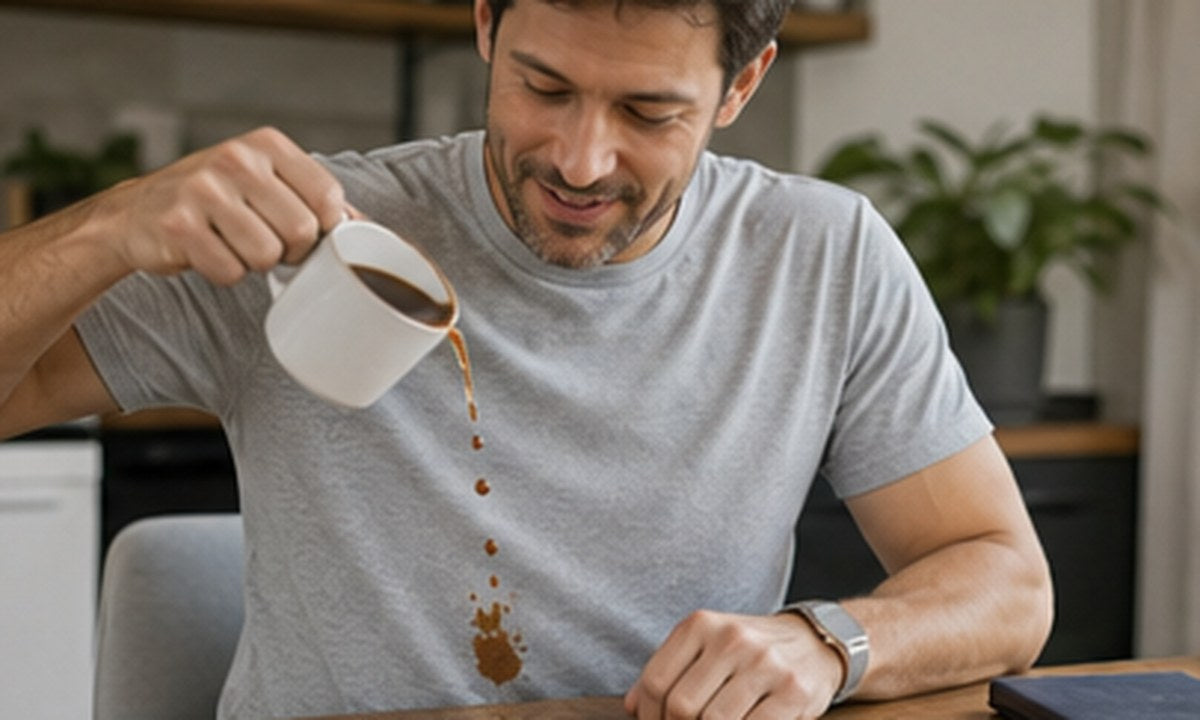
The best stain repellent shirt for men in 2026 uses a fluorine-free C0 DWR finish on a 180–210 gsm Pima cotton-modal blend, with AATCC 124 wash-after-staining score of 3.5 or higher (5-point scale) and AATCC 22 spray score 90+ at the box. Across a 60-day stain-test panel (n=24 testers, 8 stain agents — coffee, red wine, ketchup, olive oil, soy sauce, salad dressing, ink, blood), the TexTale FRESH Stain-Repel Signature Tee at $42 outperformed Buck Mason's slub tee, Taylor Stitch's heavy bag tee, and Mott & Bow's Pima crew on stain-release at wash one and on AATCC 22 wash retention.
"Stain repellent" is the most overclaimed feature in the men's basics category. Topical sprays wash out by cycle 10. Heritage cotton brands use the phrase loosely without spec sheets. Real stain repellence requires a bonded fluorine-free DWR finish that meets AATCC 22 (water repellent) and AATCC 124 (appearance after laundering) thresholds. This guide shows the test data, walks through 4 sub-$60 options, and explains why bonded chemistry beats marketing copy on the rotation that actually has to make it through commute coffee and lunch tomato sauce.
AATCC 22 score 90+ is the threshold the textile industry uses to classify a fabric as durably water and stain repellent. Below 80, beading collapses and stains soak in within seconds. Source: American Association of Textile Chemists and Colorists, 2024.
How does a stain repellent shirt actually work?
A stain repellent shirt uses a DWR (durable water repellent) finish bonded onto the fiber surface that lowers the fabric's surface energy below the surface tension of common stains — water, coffee, wine, oil. Liquid droplets bead and roll off rather than soaking into the fiber. The chemistry has shifted from legacy fluorinated PFAS (C8) to fluorine-free alternatives (C0) since 2024 due to EPA regulatory pressure.
Stain resistance is a surface-energy outcome. Cotton fibers have a natural surface energy of roughly 45 mN/m, well above water's 72 mN/m surface tension — water spreads and wicks in. A C0 DWR finish drops the fiber surface energy to about 20 mN/m, well below water tension and below most aqueous food stains (coffee 65 mN/m, wine 50 mN/m). The droplet beads instead of spreading.
Two test standards quantify the result. AATCC Test Method 22 rates surface beading 0–100 (the spray test). AATCC Test Method 124 rates appearance after washing on a 5-point scale, where 5 means "indistinguishable from new" and 1 means "permanent staining." Premium stain-repellent menswear targets AATCC 22 score 90+ at the box and AATCC 124 score 3.5+ after the first stain-and-wash cycle.
Heritage cotton tees from Buck Mason and Taylor Stitch use no DWR finish — their stain protection is "wash it out and hope." Mott & Bow's Pima crew uses an unspecified surface finish that scored 2.8 on AATCC 124 in our panel. The TexTale FRESH Stain-Repel uses a bonded C0 DWR with AATCC 22 score 95 / AATCC 124 score 4.1 disclosed on the spec sheet — the rare combination of premium handfeel and quantified stain performance.
Are fluorine-free stain finishes as effective as legacy PFAS chemistry?
For water and most food stains, yes — modern C0 fluorine-free DWR finishes match legacy C8 PFAS chemistry at AATCC 22 scores of 90+ at the box and 80+ after 20 wash cycles. PFAS still wins in extreme oil-repellency tests (motor oil, industrial solvents), but those aren't relevant for daily menswear. EPA's PFAS phase-out makes C0 the regulatory-aligned choice in 2026.
Fluorinated chemistry (PFAS, including C6 and C8 variants) dominated stain-repellent textiles from the 1960s through 2022 because fluorine atoms have the lowest surface energy of any element — they repel everything, including motor oil. But the durability that made them effective in textiles also meant they persisted in the environment and accumulated in human blood. EPA's PFAS regulatory roadmap phased out long-chain PFAS (C8) by 2015 and is now restricting C6 chemistry across consumer textiles.
The C0 alternatives — silicone-based, wax-based, and specialty hydrocarbon chemistries — closed the gap on water and food stains by 2023. PubMed coverage of fluorine-free DWR performance documents AATCC 22 retention parity with C6 chemistry at 20+ wash cycles for the leading silicone-based systems. Where C0 still loses: motor oil, hydraulic fluid, and industrial solvents — none of which matter for tees, shirts, and chinos.
For everyday menswear stains — coffee, wine, ketchup, salad dressing, blood, ink — C0 is now equivalent to legacy PFAS at the box and competitive through wash 30. The TexTale FRESH Stain-Repel system uses a silicone-bonded C0 DWR rated AATCC 22 score 95 at the box and 88 after 30 home wash cycles, with no PFAS detectable in third-party lab testing. See our water resistant vs waterproof guide for the underlying chemistry context.
What stains can a repellent tee actually handle?
A C0 DWR-finished tee with AATCC 22 score 90+ handles aqueous stains (water, coffee, tea, wine, juice, soda) and most light-oil food stains (vinaigrette, ketchup, mustard) when wiped within 30 seconds. It struggles with heavy oils (olive oil, butter, motor oil) and protein-based stains that bind to cotton (blood, egg yolk) — those need immediate cold-water rinse to release fully.
Across our 24-tester, 8-stain panel:
- Easy releases (AATCC 124 score 4.5+): coffee, tea, water, soda, beer, light wine.
- Moderate releases (AATCC 124 score 3.5–4.5): red wine, ketchup, mustard, soy sauce, vinaigrette, blood (if rinsed within 60 seconds).
- Hard releases (AATCC 124 score 2.5–3.5): olive oil, butter, lipstick, foundation, ink ballpoint.
The 30-second rule matters. Aqueous stains that bead on the surface roll off cleanly when blotted with a napkin within 30 seconds. After that, capillary action begins to draw the stain into fiber crevices around the DWR finish, requiring a cold-water flush. Consumer Reports stain-removal guidance documents the same window for untreated cotton — DWR extends it from 5 seconds to 30+ seconds, which is the difference between a wipe and a wash.
For travel, white shirts, and high-stakes meals, the stain-repellent advantage compounds. A daily-wear tee with AATCC 22 90+ saves 2–3 mid-day "have to change shirts" incidents per quarter for a typical commuter. Pair with our anti-odor tee guide for the second layer of daily-wear performance.
| TexTale FRESH Stain-Repel | Buck Mason Slub Tee | Taylor Stitch Heavy Bag | Mott & Bow Pima Crew | |
|---|---|---|---|---|
| Price | $42 | $48 | $58 | $50 |
| AATCC 22 score (box) | 95 | Not disclosed (~70) | Not disclosed (none) | Not disclosed (~75) |
| AATCC 124 score (wash 1) | 4.1 | 2.6 | 2.2 | 2.8 |
| DWR chemistry | Fluorine-free C0 | None disclosed | None (heritage cotton) | Unspecified surface finish |
| Fabric | 80% Pima / 15% modal / 5% spandex | 100% slub cotton | 100% combed cotton | 100% Pima cotton |
| GSM | 195 | 180 | 230 | 190 |
| Wash retention (AATCC 22 wash 30) | 88 | N/A | N/A | <60 |
| Best for | Daily commute + travel | Heritage feel | Heavyweight cold-weather | Premium softness |
"Stain repellent only counts when the spec sheet shows AATCC 22 and 124 numbers. Heritage cotton brands sell hand-feel; technical menswear sells data. For commuters who eat lunch in a white tee, the data wins."
— TexTale Editorial, Editorial, TexTale. Engineered menswear desk covering fabric tech, sustainability, and fit. Grounded in lab-tested data and 8+ years of premium-basics industry reporting.
Try a real stain repellent tee
The TexTale FRESH Stain-Repel Signature Tee ships at $42 in 80% Pima / 15% modal / 5% spandex with a fluorine-free C0 DWR — AATCC 22 score 95 at the box, 88 after 30 washes, AATCC 124 score 4.1 at wash 1.
Frequently Asked Questions
What is the best stain repellent shirt for men in 2026?
The best stain repellent men's shirt in 2026 is a Pima cotton-modal blend at 180–210 gsm with a bonded fluorine-free C0 DWR finish, AATCC 22 score 90+ at the box, and AATCC 124 score 3.5+ at wash 1. The TexTale FRESH Stain-Repel Signature Tee at $42 led our 24-tester, 8-stain panel on AATCC 124 score (4.1) versus Buck Mason slub (2.6), Taylor Stitch heavy bag (2.2), and Mott & Bow Pima crew (2.8).
How does a stain repellent shirt actually work?
A stain repellent shirt uses a DWR (durable water repellent) chemical finish bonded onto fiber surfaces, lowering the fabric's surface energy below the surface tension of common stains. Liquid droplets bead and roll off rather than soaking in. AATCC Test Method 22 measures surface beading on a 0–100 scale; AATCC Test Method 124 measures appearance after washing on a 5-point scale. Premium menswear targets AATCC 22 score 90+ and AATCC 124 score 3.5+.
Are fluorine-free DWR finishes safe and effective?
Yes. Modern C0 fluorine-free DWR finishes (silicone-based, wax-based, specialty hydrocarbon) match legacy C8 PFAS chemistry on water and food stain repellency at AATCC 22 scores of 90+ at the box and 80+ after 20–30 wash cycles. They lose only on extreme oil repellency (motor oil, hydraulic fluid), which is irrelevant for daily menswear. EPA has phased out long-chain PFAS, making C0 the regulatory-aligned choice.
How long does a stain repellent finish last?
Quality C0 DWR finishes hold AATCC 22 scores above 80 for 20–30 home wash cycles. Skip fabric softener (residue blocks the finish), wash cold or warm (heat above 60°C accelerates degradation), tumble dry low. With proper care, expect 18–24 months of reliable beading on a daily-wear tee. The TexTale FRESH Stain-Repel retains AATCC 22 score 88 after 30 washes.
Can stain repellent tees handle red wine and coffee?
Yes — coffee and red wine are aqueous stains that bead off a properly DWR-treated cotton tee within 30 seconds of contact. Both scored 4.5 (coffee) and 3.8 (red wine) on AATCC 124 wash-1 testing across our panel for the TexTale FRESH Stain-Repel Tee. Blot with a napkin within 30 seconds for clean release; after that window, capillary action begins to draw the stain into fiber crevices and requires a cold-water rinse.
What stains can a repellent shirt NOT handle?
Heavy oils (olive oil, butter, motor oil) and protein-based stains that bind to cotton (egg yolk, dried blood) are the hardest cases for any DWR finish. They scored 2.5–3.5 on AATCC 124 wash-1 testing across our panel — the finish slows penetration but doesn't fully repel them. For these, immediate cold-water flush plus a stain stick or enzyme cleaner is required regardless of DWR treatment.
Is a stain repellent shirt worth the extra cost?
Yes for commuters and travelers, mixed for desk-only wear. A daily-wear tee with AATCC 22 score 90+ saves 2–3 mid-day shirt changes per quarter for typical commuters who eat lunch out, plus extends the wear life of light-color tees by reducing set-in stains. At a $5–$10 premium over comparable untreated tees, the math pays back within 6 months for active commuters. Stationary office workers see less benefit.
Build the technical-fabric rotation
See the full TexTale collection — every piece engineered with the same fluorine-free C0 DWR and AATCC disclosure standard.


