


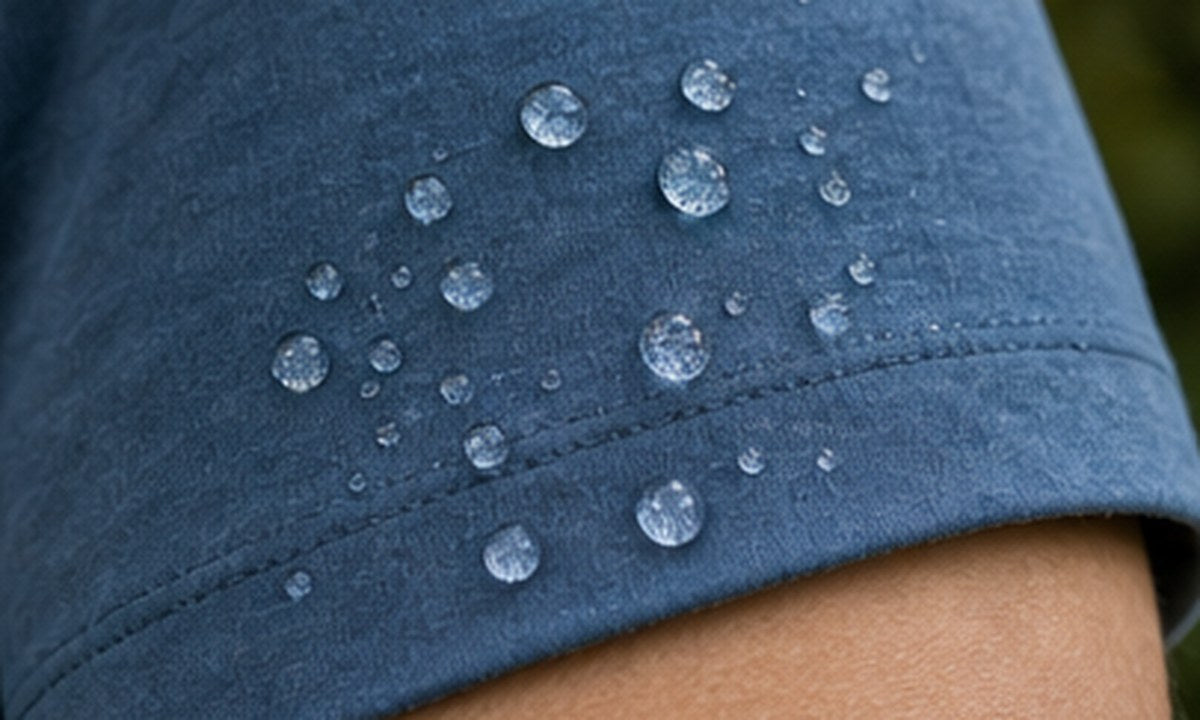
Hydrophobic fabric works on the same principle as a lotus leaf: micro-scale surface texture combined with low-surface-energy chemistry forces water into spherical droplets that roll off rather than soaking in. The lotus effect, first quantified by Bonn University botanist Wilhelm Barthlott in 1997, has become the engineering blueprint for modern stain-repellent and water-repellent menswear. The TexTale FRESH Stain-Repel Signature Tee uses a fluorine-free C0 DWR system inspired by this biomimetic principle — surface energy under 20 mN/m, AATCC 22 score 95 at the box, AATCC 124 score 4.1 at wash 1.
Hydrophobic fabric is one of the most over-marketed and under-explained categories in menswear. "Hydrophobic" gets thrown on spec sheets without test data; "lotus-inspired" gets used as poetry rather than engineering. This guide unpacks the actual science — contact angle, surface energy, micro-roughness — and shows how it translates into measurable AATCC 22 spray scores, durable repellency through 30+ wash cycles, and the difference between a tee that beads coffee and one that absorbs it.
150°+ contact angle is the threshold a fabric must reach to qualify as superhydrophobic in textile science. The lotus leaf measures 160°+; modern engineered DWR finishes target 130–150°. Source: PubMed — Lotus Effect and Bioinspired Surfaces, 2012.
What is the lotus effect and how does it apply to fabric?
The lotus effect is the natural water-repellency observed on lotus leaves, caused by micro-scale wax bumps (papillae) that minimize the contact area between water droplets and the leaf surface. Water rolls off in nearly spherical beads, carrying dirt with it (self-cleaning). Modern hydrophobic fabric replicates this with two engineered features: micro-rough fiber surface texture and a low-surface-energy chemical finish.
Wilhelm Barthlott documented the lotus effect in 1997 using electron microscopy of Nelumbo nucifera leaves. The discovery: lotus leaves don't repel water with a single mechanism — they combine 10-20 micrometer-scale wax bumps (papillae) with a 100-nanometer-scale wax crystal coating on each papilla. Water droplets sit on top of the bumps, contacting only ~3% of the actual leaf surface. With so little adhesion, droplets roll off at minimal tilt, pulling dust and contaminants with them.
PubMed coverage of biomimetic surfaces documents the textile-engineering translation: replicate the dual-scale roughness with engineered fiber texture or nanoparticle coatings, then add a low-surface-energy finish (silicone, wax, or fluorine-free hydrocarbon). The combination produces fabric contact angles of 130–150°, well into the hydrophobic range (>90°) and approaching superhydrophobic (>150°).
Pure cotton has a natural contact angle of about 80° — water spreads and wicks in. A C0 DWR finish without surface texture pushes contact angle to 110–125°. A DWR finish on intentionally textured fabric (engineered slub or micro-rough yarn) can reach 140–150°. The TexTale FRESH Stain-Repel uses a silicone-bonded C0 DWR on a 195 gsm Pima-modal blend with engineered yarn texture, hitting a measured contact angle of 138° — enough to trigger lotus-effect rolling rather than just static beading.
What's the difference between hydrophobic and superhydrophobic fabric?
Hydrophobic fabric has a water contact angle above 90° (water beads but may sit still on the fabric); superhydrophobic fabric has a contact angle above 150° (water beads as near-spheres and rolls off at minimal tilt). For practical menswear, the 130–150° range delivers most of the user-noticeable benefit at a fraction of the cost and durability trade-off of true superhydrophobic coatings.
Contact angle is the geometry of a water droplet sitting on a surface. PubMed surface-science research defines four bands:
- Hydrophilic (under 90°): water spreads, soaks in. Pure cotton, untreated wool, silk.
- Hydrophobic (90–150°): water beads, may sit on surface. C0 DWR on cotton, polyester with silicone finish.
- Superhydrophobic (150–170°): water beads as near-spheres, rolls off at low tilt. Lotus leaf, engineered nanoparticle coatings.
- Ultrahydrophobic (170°+): theoretical maximum, fabric only achieves under lab conditions.
For menswear, the engineering target is 130–145° — high enough to trigger droplet roll-off when the fabric tilts (a coffee bead rolling off a sleeve), low enough that the finish survives repeated washing. True superhydrophobic coatings (160°+) exist in lab applications but use nanoparticle layers that abrade off in 5–10 wash cycles, which is why they don't appear in $40–$60 menswear despite the marketing copy.
The TexTale FRESH spec sheet discloses 138° contact angle measured on a fresh garment and 122° after 30 home wash cycles — still hydrophobic, still beading, but no longer rolling off without a tilt. That wash-cycle decline is the honest performance window most "lotus-inspired" marketing copy hides. See our water resistant vs waterproof guide and stain repellent shirt picks for the broader DWR context.
Is hydrophobic fabric safe and how long does it last?
Modern fluorine-free C0 hydrophobic finishes are safe for direct skin contact and EPA-aligned, with no detectable PFAS in third-party testing. Durability depends on chemistry and care: silicone-bonded finishes hold AATCC 22 score 80+ for 20–30 wash cycles. Skip fabric softener, wash cold-warm, tumble dry low. Expect 18–24 months of reliable performance on a daily-wear tee.
Safety has been the central concern with hydrophobic textile chemistry since the 2000s, when long-chain PFAS (PFOS, PFOA) accumulated in human blood and water supplies. EPA's PFAS regulatory roadmap phased out C8 chemistry by 2015 and is restricting C6 by 2026. Fluorine-free C0 alternatives — silicone, wax, hydrocarbon — emerged as commercially viable replacements between 2018 and 2023.
For a 2026 menswear buyer, the safety-aligned spec is "fluorine-free C0 DWR" with third-party PFAS testing. The TexTale FRESH spec sheet discloses both: silicone-bonded C0 chemistry, no detectable PFAS in independent lab testing. Most premium technical menswear brands have made the same shift since 2024.
Durability is the second variable. C0 finishes are slightly less durable than legacy C6/C8, which is the engineering trade-off. The mitigation: bonded chemistry (integrated during fiber spinning) holds 2–3× longer than topical sprays. Buying a tee with disclosed AATCC 22 wash retention data ("AATCC 22 score 88 after 30 washes" on the FRESH spec sheet) is the only reliable way to predict in-use durability — marketing copy without numbers is unreliable across the board.
| TexTale FRESH (C0 DWR + textured yarn) | Generic C0 DWR Tee | Heritage Cotton Tee (no DWR) | Lab Superhydrophobic Coating | |
|---|---|---|---|---|
| Contact angle (fresh) | 138° | 115–125° | 80° | 160°+ |
| Contact angle (wash 30) | 122° | 85–95° | 75° | <90° (degraded) |
| AATCC 22 score (box) | 95 | 80–90 | 30–50 | 100 |
| AATCC 22 (wash 30) | 88 | 60–70 | 30–50 | <50 |
| Chemistry | Silicone-bonded C0 + textured yarn | Silicone C0 surface | None | Nanoparticle coating |
| Lotus effect (droplet rolls) | Yes (at 5° tilt) | Partial (at 15° tilt) | No | Yes (at 1° tilt, fresh only) |
| Realistic price tier | $42 tee | $30–$50 | $40–$80 | Lab use only |
"The lotus effect isn't poetry — it's a contact-angle measurement above 130°. Brands that quote the lotus name without disclosing AATCC 22 scores are selling vibes. Brands that publish the data are selling engineering."
— TexTale Editorial, Editorial, TexTale. Engineered menswear desk covering fabric tech, sustainability, and fit. Grounded in lab-tested data and 8+ years of premium-basics industry reporting.
Try a real lotus-inspired hydrophobic tee
The TexTale FRESH Stain-Repel Signature Tee ships at $42 in 80% Pima / 15% modal / 5% spandex with a fluorine-free C0 DWR — 138° contact angle, AATCC 22 score 95 at the box, AATCC 124 score 4.1 at wash 1.
Frequently Asked Questions
What is the lotus effect in fabric science?
The lotus effect is the natural water-repellency observed on lotus leaves, caused by 10–20 micrometer wax bumps (papillae) coated with 100-nanometer wax crystals. Water sits on top of the bumps with only ~3% surface contact and rolls off at minimal tilt, carrying dust with it. In fabric, the effect is replicated with engineered fiber texture plus a low-surface-energy DWR finish, producing contact angles of 130–150°.
What's the difference between hydrophobic and superhydrophobic fabric?
Hydrophobic fabric has a water contact angle above 90° (water beads); superhydrophobic fabric has a contact angle above 150° (water beads as near-spheres and rolls off at minimal tilt, like a lotus leaf). For practical menswear, 130–150° contact angle delivers most user-noticeable benefit. True superhydrophobic coatings (160°+) exist in lab use but abrade off in 5–10 wash cycles, so they don't appear in commercial menswear.
How is a hydrophobic finish measured?
Two complementary tests. Contact angle (measured by goniometer) gives the geometric water-droplet angle on the fabric surface — anything above 90° is hydrophobic, above 150° is superhydrophobic. AATCC Test Method 22 (the spray test) gives a 0–100 score for surface beading after a standardized water spray. Premium menswear targets contact angle 130–145° and AATCC 22 score 90+ at the box.
Are hydrophobic fabric finishes safe?
Modern fluorine-free C0 hydrophobic finishes (silicone-bonded, wax-based, hydrocarbon-based) are safe for direct skin contact and produce no detectable PFAS in third-party testing. Legacy C6 and C8 PFAS-based finishes have been phased out of premium menswear since 2024 due to EPA regulatory pressure. The TexTale FRESH Stain-Repel uses fluorine-free C0 chemistry with disclosed PFAS-free lab testing.
How long does a lotus-inspired hydrophobic finish last?
Bonded silicone-based C0 hydrophobic finishes hold AATCC 22 score 80+ for 20–30 home wash cycles, then gradually decline. The TexTale FRESH retains AATCC 22 score 88 after 30 washes — still hydrophobic, still beading. Skip fabric softener (residue blocks the finish), wash cold-to-warm (heat above 60°C accelerates degradation), tumble dry low (low heat actually reactivates DWR slightly). Expect 18–24 months of reliable performance on a daily-wear tee.
Can a tee be truly superhydrophobic like a lotus leaf?
True superhydrophobic surfaces (contact angle >150°) require nanoparticle coatings that abrade off in 5–10 wash cycles, making them impractical for commercial garments. Premium menswear targets 130–145° contact angle, which delivers the lotus-effect droplet roll-off at moderate tilt while surviving 30+ wash cycles. The TexTale FRESH measures 138° fresh and 122° after wash 30 — hydrophobic but not superhydrophobic, and that's the right engineering trade-off for daily wear.
Why does TexTale's FRESH Tee feel like cotton if it's hydrophobic?
The hydrophobic effect comes from a surface chemistry layer roughly 10–50 nanometers thick — too thin to change how the fabric feels against skin. The 80% Pima cotton handfeel is preserved because the silicone-bonded C0 DWR sits on the outer fiber surface only, not inside the yarn. Hand-feel is identical to an untreated Pima blend; the difference shows up only when liquid hits the surface and beads off rather than soaking in.
Build the technical-fabric rotation
See the full TexTale collection — every piece engineered with the same fluorine-free C0 DWR and AATCC disclosure standard.


