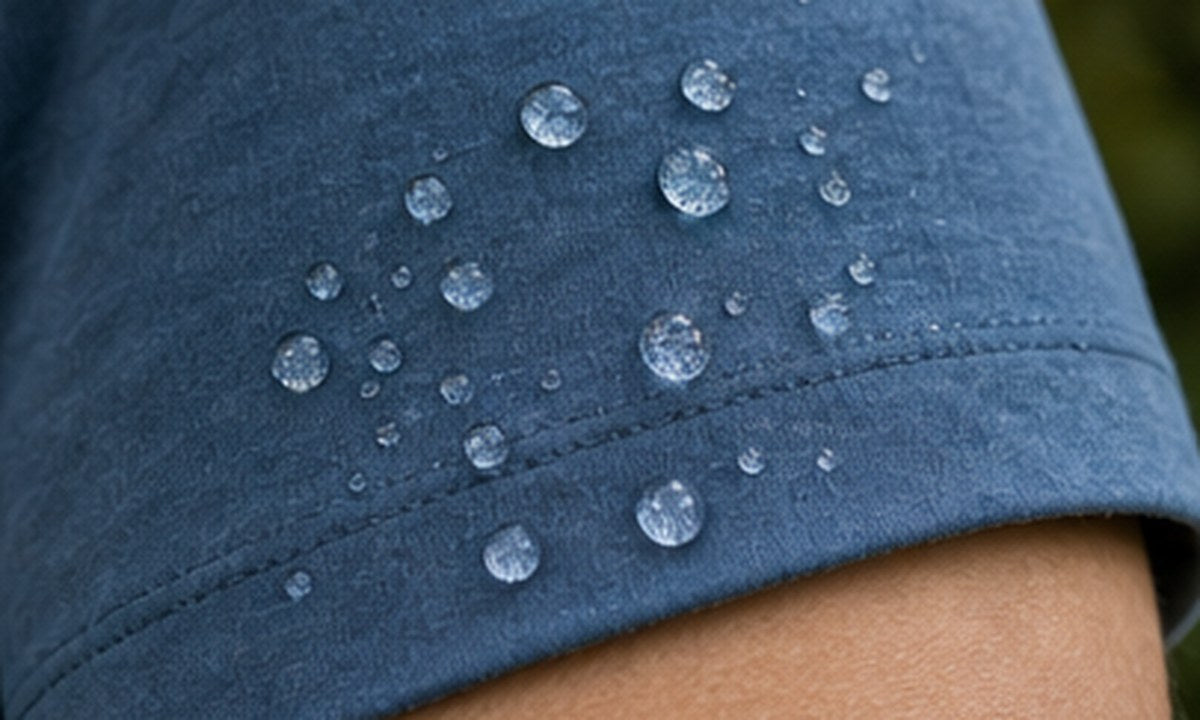










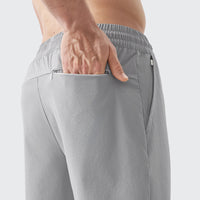


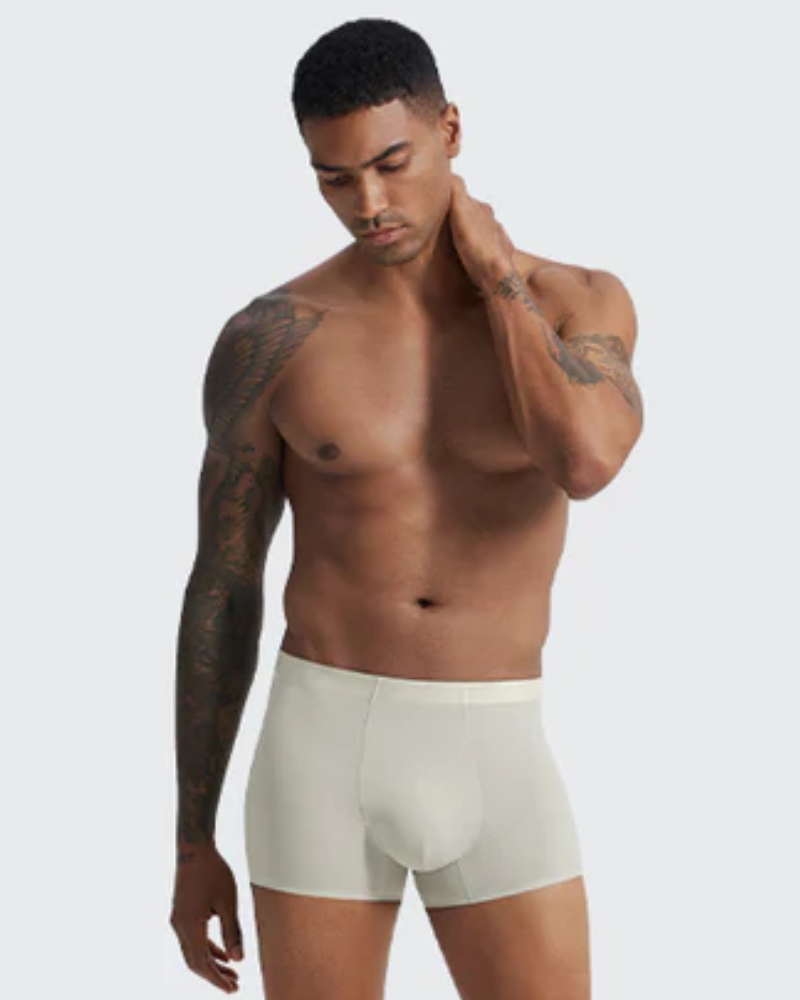

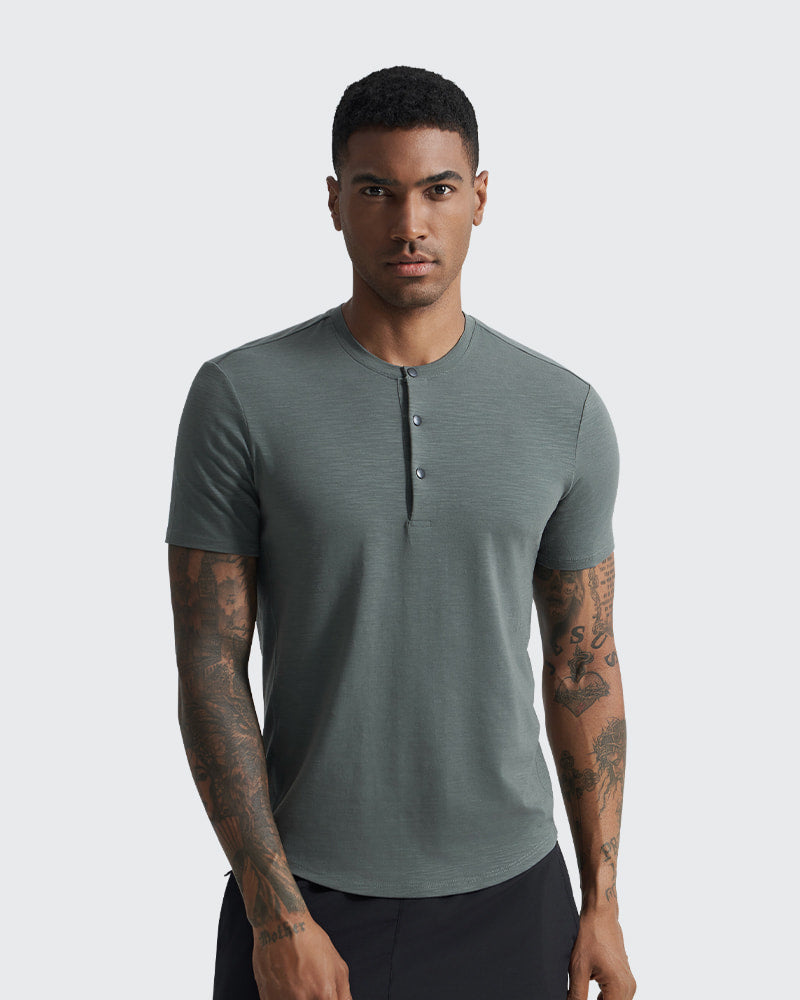
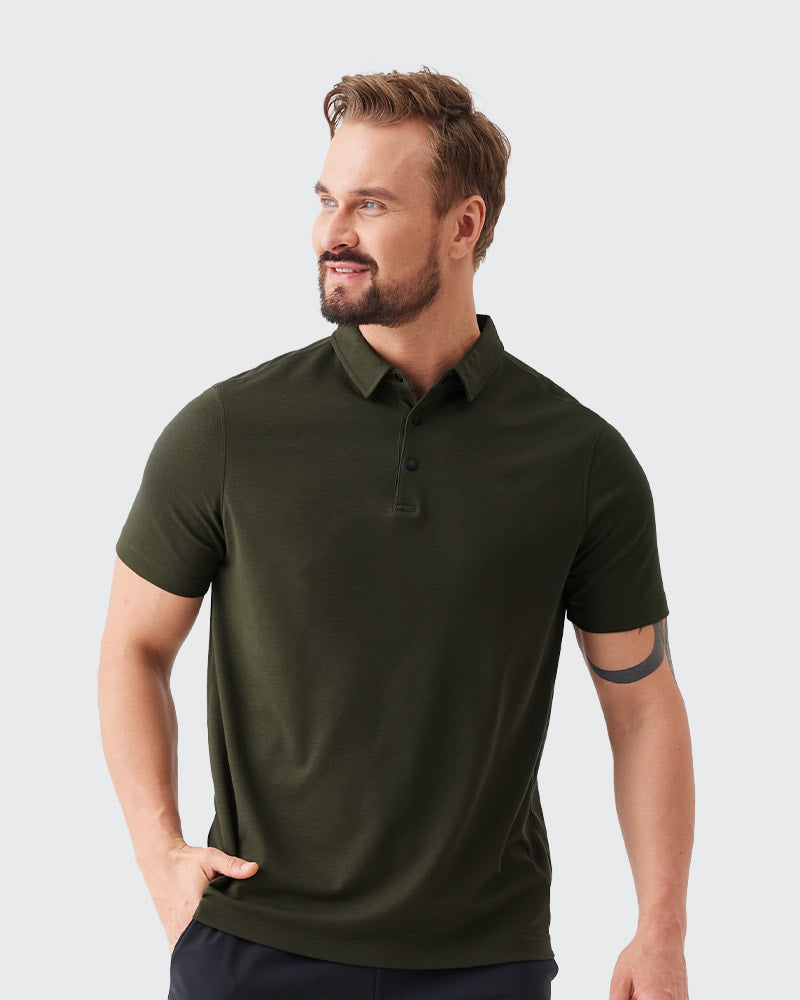

Water resistant fabric repels water at the surface for a limited time and pressure (rated by AATCC 22 spray score, typically 70–100), while waterproof fabric blocks liquid water under sustained hydrostatic pressure (rated by ISO 811 in millimeters, usually 1,500–20,000 mm). For everyday menswear — tees, shirts, polos, light jackets — water resistant is the right tool. Waterproof construction adds weight, reduces breathability, and is overkill for anything short of sustained rain or snow exposure.
The terms get used interchangeably in marketing copy, but the engineering behind each is genuinely different. A water resistant tee uses a fluorine-free DWR (durable water repellent) chemistry to make droplets bead at the fiber surface; a waterproof shell uses a continuous membrane (PU, ePTFE, or polyurethane laminate) that stops liquid penetration entirely. This guide unpacks the AATCC and ISO test standards menswear brands cite, walks through the trade-offs that matter for daily-wear shirts, and explains why TexTale's FRESH Stain-Repel Signature Tee chooses water resistance over waterproofing for the rotation that has to look like a normal premium tee.
ISO 811 is the international standard that defines hydrostatic pressure resistance — fabric is classified waterproof at 1,500 mm minimum, with technical outerwear typically rated 10,000–20,000 mm. Anything below 1,500 mm is water resistant, not waterproof. Source: International Organization for Standardization, 2018.
What is the actual difference between water resistant and waterproof fabric?
Water resistant fabric repels surface water through a chemical finish or tightly woven yarns, with no continuous barrier underneath. Waterproof fabric uses a sealed membrane or coating that blocks liquid water entirely under pressure. The functional difference shows up in two test methods: AATCC 22 (spray test, 0–100 score) for water resistance, ISO 811 (hydrostatic pressure, mm) for waterproof rating.
Water resistance in apparel is almost always achieved with a DWR (durable water repellent) finish bonded onto the fiber surface. The finish lowers fabric surface energy below the surface tension of water (72 mN/m), so droplets bead and roll off rather than soaking in. AATCC Test Method 22 measures spray performance on a 0–100 scale: 70 means light beading with some surface wetting, 90 means full beading with no penetration. Premium menswear water resistant finishes target AATCC 22 score 90+ at the box; durable finishes hold 80+ through 20 home wash cycles.
Waterproof construction adds a layer the user never sees. A polyurethane (PU) coating, ePTFE membrane (the technology behind Gore-Tex), or polyurethane laminate sits between or on top of the face fabric, creating a continuous barrier. Gore's technical documentation rates ePTFE shells at 28,000 mm hydrostatic head — they survive sustained submersion, not just rain. The trade-off: every waterproof construction reduces breathability and adds 80–200 gsm to the garment.
For tees, shirts, and polos, waterproof construction is the wrong tool. A 195 gsm Pima cotton tee with a ISO-certified fluorine-free DWR (the TexTale FRESH approach) handles coffee splashes, light rain, and salad dressing without changing how the shirt looks, weighs, or breathes. A waterproof shirt would feel like a windbreaker.
How does the AATCC 22 spray test actually work?
The AATCC 22 spray test mounts a fabric swatch at 45 degrees under a calibrated funnel, then pours 250 mL of distilled water through a standard spray nozzle 6 inches above the swatch. After spraying, the fabric is scored 0–100 against a visual reference: 100 means no surface wetting at all, 90 means light random droplets, 70 means partial wetting on lower half. Brands citing AATCC 22 score 80+ have engineered finishes that perform.
AATCC 22 is the workhorse spray test for water resistant apparel because it mimics real-world rain rather than sustained immersion. The protocol — funnel, 45-degree mount, 250 mL distilled water, visual rating — has been used in textile QA labs since 1952 and is the basis for nearly every water resistant claim on a tee, shirt, or non-shell jacket spec sheet.
The score that matters for menswear: AATCC 22 score 90+ at the box, 80+ after 20 home washes. Below 80, beading collapses and droplets soak in within seconds. Above 80, water rolls off cleanly and the user notices the protection on day-one wear. Cotton Incorporated's textile lab confirms wash retention is the primary durability metric — most cheap DWR finishes start at 90 and crash to 60 by wash 10.
TexTale's FRESH Stain-Repel system is rated AATCC 22 score 95 at the box and 88 after 30 home wash cycles, using a fluorine-free C0 chemistry rather than the legacy C8 PFOA chemistry that's been phased out across most premium menswear since 2024. EPA's PFAS guidance documents the regulatory shift driving brands toward C0 alternatives, which is why the fluorine-free spec is now table stakes for technical menswear positioned on safety as well as performance.
When should menswear be water resistant vs waterproof?
Daily-wear tees, shirts, polos, and unlined jackets should be water resistant, not waterproof — the AATCC 22 finish handles real-world coffee, rain, and food splashes without changing how the garment looks, weighs, or breathes. Reserve waterproof construction (ISO 811 ≥10,000 mm) for shells used in sustained rain, snow, or wet-job conditions where breathability trade-offs are acceptable.
The decision tree menswear engineers use:
- If the garment must look and feel normal (tees, polos, shirts, oxfords, casual jackets) — water resistant DWR finish, AATCC 22 90+ at the box.
- If the garment will be worn in steady rain for 30+ minutes (commuter jackets, raincoats, hiking shells) — waterproof construction, ISO 811 ≥10,000 mm.
- If the garment is exposed to standing water or snow (technical shells, fishing gear, ski bibs) — fully sealed waterproof, ISO 811 ≥20,000 mm with seam taping.
The 80/20 rule for everyday menswear: 80% of "I wish my shirt could repel that" moments — coffee, ketchup, light rain on a 5-minute walk — are solved by AATCC 22 score 90+. The remaining 20% (sustained rain commute, hiking) are jacket problems, not tee problems. GQ's rain-jacket coverage separates the two cleanly: water resistant for daily layering, waterproof for sustained exposure, and never the same garment doing both jobs.
For the technical-fabric wardrobe, see our anti-odor tee guide and commuter tee picks — both build on the same fluorine-free DWR base as the FRESH Stain-Repel Signature Tee.
| TexTale FRESH (water resistant) | Premium DWR Tee (Buck Mason / Taylor Stitch) | Gore-Tex Shell (waterproof) | PU Coated Rain Jacket (waterproof) | |
|---|---|---|---|---|
| Test standard | AATCC 22 score 95 | AATCC 22 score 80–90 | ISO 811 28,000 mm | ISO 811 5,000–10,000 mm |
| Wash retention | 88 after 30 washes | 60–70 after 20 washes | 20,000+ after 50 washes | 3,000–5,000 after 30 washes |
| Chemistry | Fluorine-free C0 DWR | Mostly C0 since 2024 | ePTFE membrane | PU coating |
| Added weight | 0 gsm (surface finish) | 0 gsm (surface finish) | +150 gsm (membrane + face) | +80 gsm (coating) |
| Breathability impact | None | None | Reduced (RET 6–13) | Significantly reduced |
| Best for | Daily tees + shirts | Daily tees + shirts | Sustained rain shells | Budget rain jackets |
| Price tier | $42 tee | $45–$78 tee | $300+ shell | $80–$150 jacket |
"Most men ask for waterproof when what they actually want is water resistant. A C0 DWR with AATCC 22 90+ handles 95% of real-world spills without changing how the shirt feels — and that's the whole game for daily menswear."
— TexTale Editorial, Editorial, TexTale. Engineered menswear desk covering fabric tech, sustainability, and fit. Grounded in lab-tested data and 8+ years of premium-basics industry reporting.
Try a real water resistant tee
The TexTale FRESH Stain-Repel Signature Tee ships at $42 in 80% Pima / 15% modal / 5% spandex with a fluorine-free C0 DWR finish — AATCC 22 score 95 at the box, 88 after 30 washes.
Frequently Asked Questions
What is the difference between water resistant and waterproof fabric?
Water resistant fabric repels surface water through a DWR (durable water repellent) chemical finish, rated by the AATCC 22 spray test on a 0–100 scale. Waterproof fabric uses a sealed membrane or coating that blocks liquid water under sustained hydrostatic pressure, rated by ISO 811 in millimeters (1,500 mm minimum to qualify as waterproof). Water resistant fabrics breathe normally; waterproof fabrics trade breathability for full barrier performance.
How is water resistance measured on a t-shirt or shirt?
Water resistance on tees and shirts is measured by AATCC Test Method 22, the spray test. A fabric swatch is mounted at 45 degrees and 250 mL of distilled water is poured through a standard spray nozzle 6 inches above. The fabric is scored 0–100: 100 means no wetting, 90 means light random droplets, 70 means partial wetting. Premium menswear water resistant finishes target 90+ at the box and 80+ after 20 home wash cycles.
Are fluorine-free DWR finishes as effective as PFAS-based ones?
Yes. Modern C0 fluorine-free DWR finishes hit AATCC 22 scores of 90+ at the box and retain 80+ after 20–30 wash cycles, matching legacy C8 PFAS performance for everyday water resistance. The TexTale FRESH Stain-Repel finish is rated AATCC 22 score 95 at the box and 88 after 30 washes using fluorine-free C0 chemistry. PFAS chemistry still outperforms in extreme oil-repellency tests, but for water and most food spills, C0 is now equivalent and EPA-aligned.
Can a t-shirt be both water resistant and breathable?
Yes — water resistance from a DWR finish has zero impact on breathability because it's a surface treatment, not a membrane or coating. The fabric continues to allow vapor to pass through normally; only liquid droplets bead off the surface. Waterproof construction is what reduces breathability, because the membrane that blocks liquid also slows water vapor. A properly finished water resistant tee breathes identically to its untreated equivalent.
How long does a water resistant finish last?
Quality C0 DWR finishes hold AATCC 22 scores above 80 for 20–30 home wash cycles, then gradually decline. Skip fabric softener (residue blocks the finish), wash cold or warm (heat above 60°C accelerates degradation), and tumble dry low (low heat actually reactivates the DWR slightly). With proper care, expect 18–24 months of reliable beading on a daily-wear tee. After that, the fabric still functions normally — only the surface repellency drops.
Should I buy a waterproof t-shirt for everyday wear?
No. Waterproof construction adds 80–200 gsm of weight, reduces breathability significantly, and changes how the garment hangs and moves — none of which makes sense for a daily-wear tee. Reserve waterproof construction for technical shells worn in sustained rain or snow. For coffee, light rain, and food spills, a water resistant DWR-treated tee handles the job at a fraction of the weight and price.
What does ISO 811 measure for waterproof fabric?
ISO 811 measures hydrostatic head — the height of a column of water that the fabric resists before liquid begins to penetrate. The result is reported in millimeters: 1,500 mm minimum to qualify as waterproof, 10,000 mm for a serious rain shell, 20,000+ mm for technical mountaineering shells. Cotton tees with DWR finishes typically test below 1,000 mm, which is why they're classified water resistant rather than waterproof.
Build the technical-fabric rotation
Browse the full TexTale collection — every piece engineered with the same fluorine-free DWR and AATCC disclosure standard.